

Insight9 min
The vocational route is finally getting honest treatment
UBTEB enrolment is up 22% in three years. We visited the institutes turning out the country's electricians, welders and ICT technicians.
28 Jan 2026Read
Insight
Skilled-trade graduates are landing jobs faster than many degree holders. The institutes behind the shift.

By Joshua Mwesigwa, Senior Editor
Published 10 min read
Read summarized version with:
For a long time the vocational route carried a quiet stigma in Uganda, the path for the pupil who could not manage the academic one, a consolation prize dressed up as a choice. That hierarchy is inverting. A competent welder, electrician or ICT technician can now be in paid, skilled work within weeks of finishing, often ahead of a peer who took the longer, more prestigious road of a general degree and emerged into a job market that did not need another generalist. Employers, short of exactly the practical skills the universities do not produce, have started recruiting from the technical institutes directly. There is a dividend here, and it is going to the schools that earned it.
The reversal is driven by a simple mismatch. The economy needs people who can do specific, practical things, wire a building, weld a joint that holds, keep a network running, and it does not need them in some abstract future but now. A general degree, by contrast, certifies a broad competence that an employer must then translate into a usable skill at their own expense and risk. Faced with that choice, a growing number of employers prefer the candidate who can already do the job, and the vocational graduate increasingly is that candidate.
This is not an argument that degrees are worthless; many careers still require them, and the comparison is not uniform across every trade and field. But it is an argument that the assumed superiority of the academic route over the vocational one no longer holds automatically, and that a school-leaver weighing the two should look at outcomes rather than prestige. The fastest route into paid work, for a great many young Ugandans, now runs through a workshop rather than a lecture hall.
Not every technical institute produces the dividend. The TVET label, like any label, covers both the serious and the negligent. The institutions that actually move graduates into work share a recognisable set of features.
I no longer ask a young technician where they studied. I ask what they can build by Friday. The institutes that understand that question are the ones I keep hiring from.
The dividend is not spread evenly. It is largest in the trades where demand visibly outstrips supply and where competence is immediately verifiable: construction trades like welding and electrical work, plumbing, motor mechanics, and practical ICT support. In these fields an employer can assess a candidate by what they produce, the stigma of the vocational route falls away the moment the work speaks, and a capable graduate is genuinely scarce. The institutions a school-leaver should be looking at are those with a track record of placing graduates into exactly these in-demand trades, not those that simply offer the courses.
It is worth being honest about the limits too. The vocational route rewards the trades the market is short of, and a young person should choose the field with an eye to demand rather than convenience. A workshop full of trainees in a saturated trade produces the same disappointment as a lecture hall full of graduates in one. The dividend is real, but it is specific.
For a school-leaver, and for the parents steering the decision, the practical advice is to treat the vocational route as a serious option to be evaluated on its merits, not a fallback to be accepted in disappointment. Look at which institutes have live employer relationships and real equipment. Ask where their graduates end up and how quickly. Choose a trade the market is actually short of. Done that way, the vocational route is not a step down from the academic one. For a growing number of young Ugandans, it is the faster, surer step into paid and skilled work, and the employers have already noticed.
Discover, compare and shortlist schools across every curriculum in Uganda.
Browse schoolsUBTEB enrolment is up 22% in three years. We visited the institutes turning out the country's electricians, welders and ICT technicians.
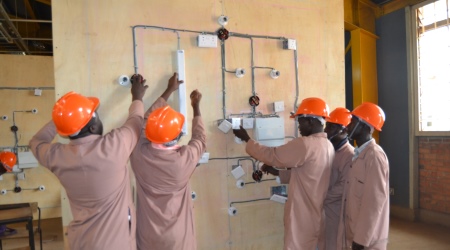
The case for technical education used to be made apologetically. The new infrastructure makes it without apology.

The prospectus is polished. These questions get you past it to how the school actually runs.
Newsletter
One considered email a month, the pieces worth your time, and nothing else.
Praecip keeps editorial independent: our verdicts are never for sale, and any sponsored piece is clearly labelled.